
|
||
Hampton Court Place and Gardens in LondonHampton Court Palace is located on the bank of the River Thames in southwest London, opposite Kingston upon Thames. There have been many different owners of the palace. Knights, Archbishops and many Royal owner have all placed their own mark the buildings and its grounds. It is home to the world famous Royal Horticultural Society's Hampton Court Palace Flower Show. This event takes place in early July of every year. 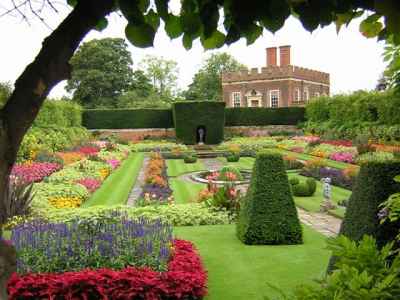 Owners of Hampton Court Through HistoryThe first buildings on this site belonged to the Knights Hospitaliers of St John of Jerusalem. They acquired the manor in 1236. It was used as a grange (centre for agricultural estates). By the 15th Century, the abbots of the Order of St John increasingly used it as a rural retreat. The first royal visit occurred in 1503. In 1505, the Lord Chamberlain, Sir G. Daubeney took a 99 year lease on the property. He used it to entertain Henry VII. Henry VIII's History with Hampton CourtThe property was leased again in 1514 for another 99 years to Thomas Wolsey, then Archbishop of York and Chief Minister to Henry VIII. He wanted to turn the house into something substantial, so as to entertain a king like Henry VIII. He added a separate set of lodgings for Henry VIII and his queen, Catherine of Aragon. But in 1528, after Mr Wolsey's failure to obtain a divorce for Henry VIII from Catherine of Aragon, he fell from favour. He then had to give Hampton Court Palace back to the King. 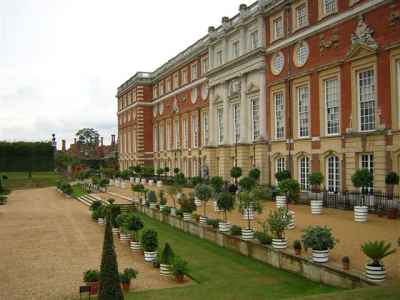 Restoration by King Henry VIII Henry VIII rebuilt the palace obscuring much of Wolsey's additions. The Base Court, Great Chamber and King's Dining Room were redesigned or torn down. He spent roughly 62000.00 GBP worth 18 GBP million today on it. Hampton Court was his fourth favourite, but he only spent 811 days here of his 38 year reign. Each of his six wives had separate rooms. Rebuilding finished in 1540 and included tennis courts, pleasure gardens and an 1100-acre hunting park. Lead pipes brought water here from 3 miles away. More Royal owners and Oliver Cromwell The next three monarchs made almost no significant modifications other than Elizabeth I who added a new kitchen, the Queen's privy kitchen. James I liked Hampton court due to its hunting and redid the 80 year old interiors. Charles I was imprisoned here after the end of the civil war in 1649. Upon its seizure by the parliamentary forces, an inventory was made with the intent to sell off its possessions. But, Oliver Cromwell, after becoming Lord Protector, decided to use it. Charles II added new rooms but they were no longer in the Tudor style. 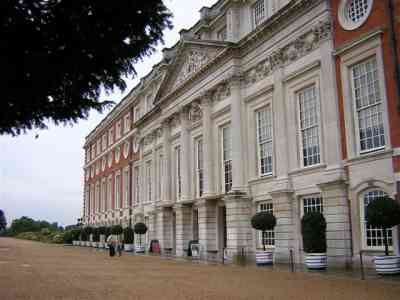 Rebuilding by Sir Christopher Wren William III commissioned Sir C. Wren to rebuild it. The new king liked the palace but wanted to modernize it. Sir. C. Wren could only rebuild the King and Queen's main apartments on the south and east sides between 1689 and 1702. He spent roughly 131000.00 GBP worth 38 million GBP today. It Became Unused, Emptied and NeglectedQueen Anne and George I rarely used the palace, but between 1715 and 1718, new Queen's apartments were set up for the Prince and Princess of Wales. George II made the last major changes by adding new lodgings on the east side of the Clock Court in 1732. They were the last ones built for a member of the royal family. Upon the death of the Queen in late 1737, George II never visited Hampton Court again. The last full court visit occurred in 1737. Once George II decided not to live in or barely use the palace, furniture was removed. It was then used for grace-and-favour residents who were granted rent-free accommodation. Lucky them. Restored and Opened to the PublicIt was Queen Victoria that Hampton Court to its' former glory. This Victorian restoration began in full in the 1830s and in the late 1880s. Queen Victoria opened the palace to the public in 1838. During the 1970s and 1980s, exhibitions were set up for the public. Inside there are some great art collections. Also, part of the Royal Collection resides here. In 1986 a fire devastated the King's Apartments. It took 6 years to restore it to the way William III had it. |
||